Can You Bring Your CPAP to a Sleep Study?
If you already use a CPAP machine and your doctor has ordered an overnight sleep study, you are probably wondering what to do with the device. Do you pack it with your pajamas, or leave it at home? The honest answer is that it depends on why you are having the study. This guide explains the common situations, what a sleep lab usually does with your equipment, and how to get a clear answer before your night.
Vector Sleep Diagnostic Center has run overnight in-lab sleep studies in Rego Park, Queens since 2005, and performs 900 to 1000 studies a year. Our medical director, Dmitriy Kolesnik, MD, is board certified in Neurology and in Sleep Medicine. The short version: always check with your sleep center first, because the right answer depends on the goal of your test.
Can You Bring Your CPAP to a Sleep Study? It Depends on the Study
Not every sleep study asks the same question. Before you decide what to pack, find out which kind of study you are having. Most people who already own a CPAP fall into one of these groups.
Common Reasons a CPAP User Has a Sleep Study
- Your treatment is not working well. The study may look at whether your current settings still fit you.
- You have used CPAP for years and are being re-evaluated. Weight changes, aging and other health changes can shift what your body needs.
- You are being tested for a different problem. Restless legs, insomnia or unusual nighttime movements may be the reason, and your CPAP is only part of the picture.
- You are having a first study and do not own a CPAP yet. In that case there is nothing to bring.
In some of these cases the technologist will want to see how you sleep with your own device. In others, the lab needs to record your sleep with its own equipment so the data is clean and consistent. Neither approach is wrong. They answer different questions.
What a Sleep Lab Usually Does With Your CPAP
A diagnostic overnight study, called polysomnography, measures what your body does while you sleep. Sensors record brain activity, breathing effort, airflow, heart rhythm, oxygen levels and body movement, and a technologist watches the recording through the night from a separate room.
Diagnostic Nights
When a person is being tested for sleep apnea, the first goal is often to see how breathing behaves without treatment. If you wear your own CPAP all night, the recording may not show the full problem. This is one reason some labs ask patients to leave the device at home for a diagnostic night, or to use it only as the technologist directs.
Titration Nights
If the study is a treatment study, called a titration, the lab uses its own CPAP equipment so the technologist can change pressure while you sleep and find the level that keeps your airway open. The American Academy of Sleep Medicine guideline for manual titration (Kushida et al., 2008) sets the recommended minimum starting CPAP at 4 cm H2O, a recommended maximum of 20 cm H2O for patients 12 and older, and increases of at least 1 cm H2O no sooner than every 5 minutes.
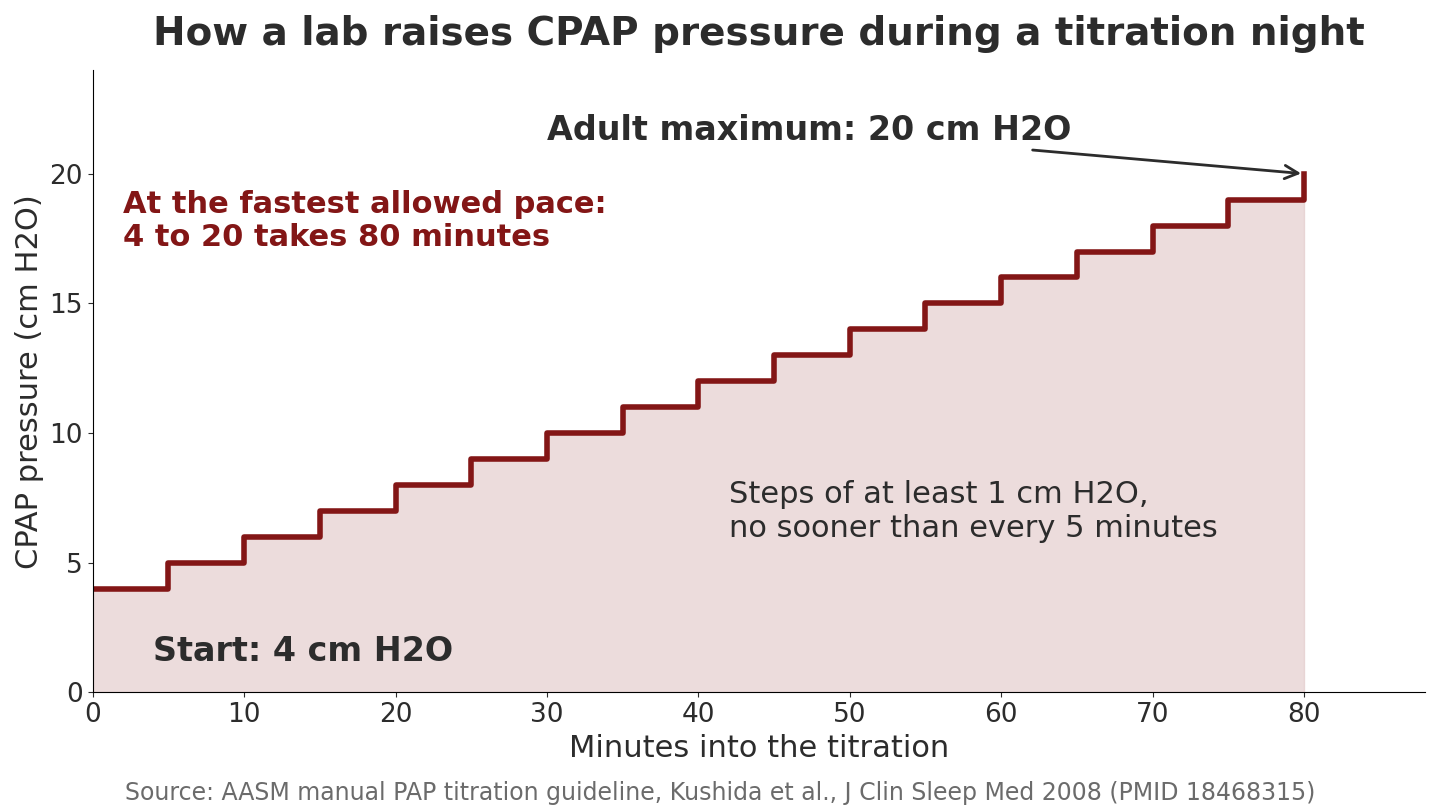
That pacing is why a lab machine matters: the technologist adjusts it remotely and records each change against your breathing. Some patients are asked to bring their own mask, since a familiar fit can make the night easier. Policies vary between sleep centers, so confirm yours directly.
The key point is not to guess. Bringing your machine when the lab did not ask for it can slow setup. Leaving it at home when it was needed can mean a repeat visit.
Questions to Ask the Sleep Center Before Your Night
A short phone call removes most of the uncertainty. When you contact the sleep center, ask:
- Is my study diagnostic, a pressure titration, or a check of my current treatment?
- Should I bring my CPAP machine, my mask, or neither?
- If I bring my mask, should I bring the tubing and headgear too?
- Should I use my CPAP the night before, or keep my routine as usual?
- Does the lab provide a humidifier if I normally sleep with one?
- What should I do about any medications I take at night?
Write down the answers and keep them with your appointment details. If your doctor gave you instructions, mention them on the call so the lab can match them to your order.
What to Bring Even if the CPAP Stays Home
Whether or not your device comes along, a comfortable night helps the recording. Our guide on what to bring to your first sleep study appointment covers the full packing list. In general, bring:
- Comfortable two piece sleepwear
- Your usual toiletries
- A list of your medications and supplements
- Your insurance card and photo ID
- A book or something quiet for winding down
- Your own pillow, if the lab confirms it is fine
If you use any other medical device at night, tell the lab ahead of time so staff can plan around it.
How to Prepare the Night Before and the Day Of
Good preparation matters as much as the equipment question. Our article on preparing the night before a sleep study goes through it in detail. The highlights:
- Wash your hair and skip heavy products, so sensors sit well on clean skin and scalp.
- Follow the lab’s guidance on caffeine and alcohol.
- Keep your day as normal as you can, and ask whether to avoid naps.
- Arrive calm and with time to spare.
If your schedule is unusual, read about the best time for a sleep study. For mix ups around equipment and instructions, see our piece on first sleep study mistakes.
In-Lab Studies, Home Tests and Your CPAP
Some patients ask whether a home test would let them keep using their own machine. A home sleep apnea test records fewer signals than an in-lab study and is built mainly to screen for obstructive sleep apnea in certain patients. It is not designed to adjust CPAP pressure. Our comparison of at-home vs in-lab sleep studies lays out the tradeoffs.
An in-lab study gives the clinical team a fuller picture, including sleep stages, limb movements and other findings a simple home device may not record. If you have complicated symptoms, or other conditions on top of suspected apnea, a lab setting is often the more complete choice. Your physician decides what is right for you. If broken sleep is the main problem, read how a sleep study can identify why you cannot stay asleep.
Why Experience With CPAP Patients Matters
Vector Sleep Diagnostic Center performs 900 to 1000 in-lab overnight sleep studies a year, used to diagnose sleep apnea, insomnia, restless legs and other sleep disorders. Our medical director is board certified in Neurology and in Sleep Medicine, which matters because sleep problems often involve both breathing and the brain. We also offer EEG studies, including prolonged EEG, so nighttime events that may not be sleep apnea can be evaluated as well. We accept all major insurance plans, including Medicare and Medicaid.
For independent background on sleep apnea and CPAP, see the National Heart, Lung, and Blood Institute and the American Academy of Sleep Medicine patient pages.
What Happens After the Study if You Use CPAP
The night is one step. A physician reviews the recording and your results are explained to you. Depending on the findings, your treatment may stay the same, change settings, or move in a new direction. Some patients learn that mask fit is the real problem, not the machine.
Keep using your CPAP as your doctor directs unless you were told to pause it for the study, and do not change pressure settings yourself. If you notice dryness, leaks or trouble falling asleep with the mask, tell your care team. Our page on the CPAP follow-up appointment explains what is usually checked.
Frequently Asked Questions
Should I bring my CPAP machine to my sleep study?
It depends on the type of study and the lab’s policy. Some studies record your sleep without treatment, and titration studies adjust pressure with the lab’s own equipment. Call the sleep center before your appointment and ask exactly what to bring.
Can I bring just my CPAP mask?
Many patients find a familiar mask more comfortable, and some labs welcome it for titration studies. Whether it helps depends on the equipment and the goal of your night, so confirm with the lab first.
Do I use my CPAP the night before the study?
Follow the instructions from the lab and your doctor. In most cases you should not change your routine on your own. If you are unsure, ask the sleep center directly.
How does the lab find the right CPAP pressure?
During a titration study the technologist raises pressure gradually while watching your breathing. The AASM guideline recommends starting at 4 cm H2O and raising pressure by at least 1 cm H2O no sooner than every 5 minutes, up to 20 cm H2O for adults. Your physician then reviews the results and decides on your plan.
Does insurance cover a sleep study if I already have a CPAP?
Coverage depends on your plan and why the study was ordered. Vector Sleep Diagnostic Center accepts all major insurance plans, including Medicare and Medicaid. Contact our office and we can help you understand your coverage.
If you use CPAP, or think you might need it, and you have questions about your upcoming sleep study, contact Vector Sleep Diagnostic Center at 62-60 99th Street in Rego Park, Queens, or call (718) 830-2800.