Does Insurance Cover A Sleep Study In New York

If you have been tossing and turning, waking up gasping, or dragging through your days on no real rest, a sleep study is often the next step your doctor recommends. But before you book anything, you are probably asking the practical question: will insurance actually pay for this? It is a fair question, and the answer is almost always yes, with some conditions attached. This guide walks through how sleep study coverage generally works in New York, what insurers typically want to see before they approve a test, and how a local clinic like Vector Sleep Diagnostic Center in Rego Park, Queens helps patients move through that process without getting stuck. Vector has been testing patients in Queens since 2005, runs 900 to 1,000 sleep studies a year, and accepts all major insurance plans, including Medicare and Medicaid.
The Short Answer: Sleep Studies Are Usually Covered
Most health insurance plans in New York, including employer plans, Medicaid managed care, and Medicare, provide coverage for sleep studies when they are medically necessary. Sleep apnea, insomnia, restless legs syndrome, and other sleep disorders are recognized medical conditions, not lifestyle issues, so insurers treat diagnostic testing for them the same way they treat testing for other health concerns. The key phrase insurers use is “medically necessary,” which means your plan wants documentation that a sleep study is the appropriate next step based on your symptoms and history, not just something you requested on your own.
This does not mean every plan pays 100 percent of the cost. Depending on your plan design, you may have a copay, a portion that applies to your deductible, or coinsurance. The type of test matters too. In-lab studies and home sleep tests are sometimes billed and reimbursed differently, so it is worth understanding both options, which we cover in more detail in our comparison of at-home versus in-lab sleep study testing.
What Insurers Typically Require Before Approving A Sleep Study
Insurance companies do not usually approve a sleep study out of nowhere. There is a general pattern most plans follow, even though the exact paperwork varies by insurer:
- A visit with a primary care doctor or specialist where your symptoms are documented (loud snoring, daytime fatigue, gasping during sleep, high blood pressure, or witnessed breathing pauses)
- A referral or order for a sleep study from that physician
- Sometimes a prior authorization submitted by the ordering provider or the sleep clinic before the test can be scheduled
- Medical records that support why a sleep study, rather than another type of testing, is appropriate
Because insurers want to see a documented reason, patients who show up with a referral and a clear symptom history generally move through approval faster than those without one. If you are not sure whether your symptoms warrant a referral, it helps to read about how a sleep study can identify the cause behind trouble staying asleep, since insurers look for the same kind of symptom pattern when deciding on coverage.
Medicare And Medicaid Coverage For Sleep Studies
Medicare
Medicare Part B covers Type I, II, III and IV sleep tests when you have clinical signs and symptoms of sleep apnea and your doctor orders the test. After you meet the Part B deductible, you pay 20 percent of the Medicare-approved amount. One detail matters for where you test: Medicare only covers a Type I study, the full overnight in-lab polysomnography, when it is done in a sleep lab facility. The exact rules are on the Medicare.gov sleep studies coverage page.
New York Medicaid
New York Medicaid and Medicaid managed care plans also generally cover sleep studies when ordered by a treating physician, though managed care plans may require prior authorization through the specific plan you are enrolled in rather than through Medicaid directly. Because Medicaid plans in New York are administered through several different managed care organizations, the exact authorization steps can vary depending on which plan you have, so it is worth confirming directly with your plan or having the ordering clinic confirm it for you.
Employer And Marketplace Insurance Plans
If you have insurance through an employer or through the New York State of Health marketplace, sleep studies fall under diagnostic testing benefits, which are typically covered similarly to other outpatient diagnostic procedures like bloodwork or imaging. Your specific out-of-pocket cost depends on your plan’s deductible, copay structure, and whether the sleep clinic performing the test is in-network.
Before scheduling, it is worth checking two things with your insurer: whether prior authorization is required, and whether the facility performing the test is in-network. A clinic that verifies benefits before your appointment can save you from a surprise bill later. This is one reason many patients across Queens and the wider city choose a local option they can talk to directly rather than a large facility where insurance questions get routed through a call center. Our overview of what to expect from a sleep study in New York walks through the testing process itself, alongside the practical steps like insurance verification.
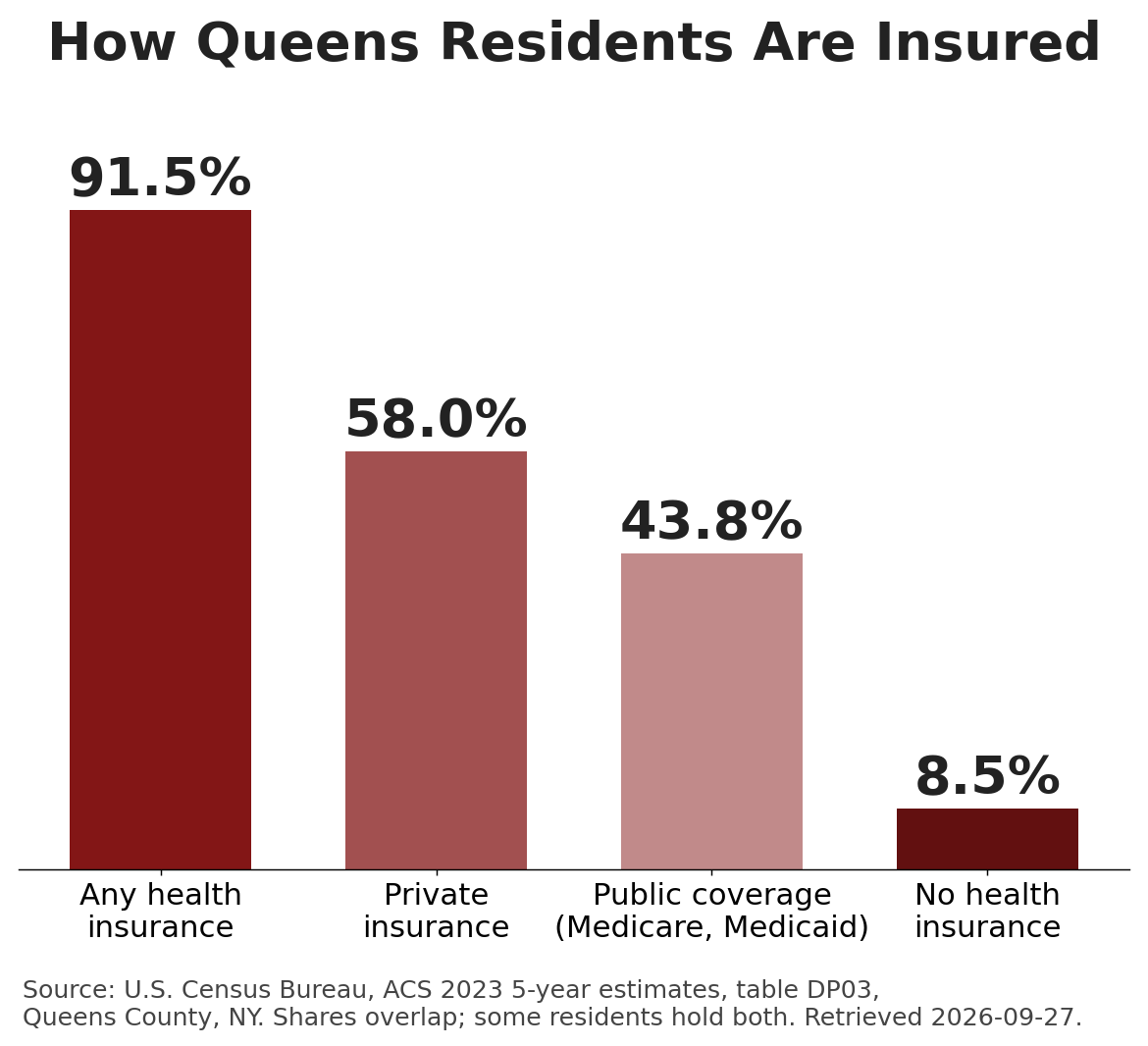
That coverage mix is why a Queens clinic has to be comfortable with every kind of plan. According to the Census Bureau, 91.5 percent of Queens residents have health insurance, 58.0 percent hold private coverage and 43.8 percent have public coverage, with some people holding both. Only 8.5 percent are uninsured. In practice, the question for most patients is not whether they are insured, but what their particular plan requires before a sleep study.
In-Lab Versus Home Sleep Testing And How That Affects Coverage
Insurance treatment of home sleep apnea tests versus in-lab polysomnography can differ. Many insurers prefer, or in some cases require, that a home sleep test be tried first for patients suspected of having obstructive sleep apnea, since it is generally less expensive than an in-lab study. If the home test is inconclusive or the doctor suspects a more complex sleep disorder such as narcolepsy, periodic limb movement disorder, or complex sleep apnea, an in-lab study becomes the appropriate next step and is typically covered as well.
Complex cases, such as patients with certain heart conditions, chronic lung disease, or suspected non-apnea sleep disorders, are often directed straight to an in-lab study because a home test would not capture enough information. Insurers generally accept this reasoning when it is documented by the ordering physician. For a deeper side-by-side look at how the two testing formats compare, both clinically and in terms of what each captures, see our guide on at-home versus in-lab sleep study testing.
Common Reasons Sleep Study Claims Get Delayed Or Denied
Even with generally favorable coverage, claims can get delayed or denied for a handful of predictable reasons:
- No prior authorization was obtained before the test, when the plan required one
- The referral or documentation did not clearly establish medical necessity
- The test was performed at an out-of-network facility without the patient realizing it
- The wrong type of test was ordered relative to what the plan’s medical policy requires as a first step
- Missing or incomplete physician notes describing symptoms
Most of these issues are avoidable with some upfront coordination. A clinic that handles scheduling and paperwork locally, rather than passing you between departments, is generally better positioned to catch these problems before they turn into a denied claim. This is part of why Vector Sleep Diagnostic Center handles appointments directly with its own team rather than through an outside call center, so patients have one point of contact for both the testing itself and the administrative side that goes with it.
If Your Claim Is Denied, You Can Appeal
A denial is not always the final word. Under federal rules summarized on HealthCare.gov, you have the right to an internal appeal, where you ask your insurance company for a full and fair review of its decision. If the internal appeal fails, you can request an external review by an independent third party, and you must file that written request within 4 months of the final denial notice. Several of the denial reasons listed above are paperwork problems, and for those the usual fix is for your physician to send the documentation that shows why the test was medically necessary.
Why Getting Tested Matters, Regardless Of Insurance Questions
Sleep disorders do not resolve on their own, and untreated sleep apnea in particular is linked to broader health risks including high blood pressure, heart strain, and daytime accidents from fatigue. Insurance questions can feel like a barrier, but they should not be the reason a suspected sleep disorder goes undiagnosed. Once you understand your plan’s requirements, the testing process itself is usually straightforward.
Sleep disorders also affect a wide range of people for different reasons. Age plays a role, and our article on how aging affects sleep disorder prevalence in New York City explains why older adults often see new sleep issues emerge. Family history matters too, which we cover in whether sleep disorders can be hereditary in New York City families. And for many people, daily habits play a bigger role than they realize, something we explore in how technology use before bed affects sleep patterns. Whatever the underlying cause, a proper diagnostic test is the only reliable way to know what is actually happening during your sleep, and comparing that to other diagnostic approaches like EEG versus sleep study testing can help clarify why a sleep study specifically is the right tool for suspected sleep disorders.
Our Experience Helping Patients Navigate Sleep Study Coverage
Vector Sleep Diagnostic Center has been testing patients from its office in Rego Park, Queens since 2005, and the team now runs 900 to 1,000 sleep studies a year. The clinic accepts all major insurance plans, including Medicare and Medicaid, so most patients who arrive with a referral already have a plan we work with. Because appointments and insurance questions are handled by our own local staff rather than a distant call center, you have one point of contact from the first phone call through your results. If your doctor has just referred you, our guide on why your primary care doctor referred you to a sleep specialist explains what that referral means, and what to bring to your first sleep study appointment covers the insurance card, ID and paperwork to have ready. After the study, the 30-day timeline for results and next steps shows what happens next.
What To Do Before You Schedule Your Sleep Study
A little preparation goes a long way toward avoiding coverage surprises. Before scheduling, it helps to:
- Talk to your primary care doctor about your symptoms and get a referral or order for a sleep study
- Call your insurance plan, or have the sleep clinic call on your behalf, to confirm whether prior authorization is required
- Confirm that the sleep clinic performing the test is in-network for your specific plan
- Ask what your expected out-of-pocket cost will be for a copay, deductible, or coinsurance before the appointment
- Keep a simple log of your symptoms, including how often they happen and how they affect your day, since this supports the medical necessity documentation your insurer will look for
If you are also dealing with the emotional side of a sleep disorder diagnosis, whether your own or a family member’s, connecting with others who understand it can help. Our page on support groups for people with sleep disorders in New York City is a good place to start looking for that kind of community support.
Want us to check your coverage before you book? Call Vector Sleep Diagnostic Center and our team will confirm what your plan needs before your sleep study.
Request an Appointment
Send your details below and our Rego Park team will contact you within one business day, or call (718) 830-2800.
Frequently Asked Questions
Do I need a doctor’s referral to get insurance to cover a sleep study in New York?
In most cases, yes. Insurance plans generally require a referral or order from a physician documenting your symptoms before they will consider a sleep study medically necessary and eligible for coverage.
Will my insurance cover a home sleep test or only an in-lab sleep study?
Many plans cover both, though some prefer a home sleep test first for suspected obstructive sleep apnea before approving an in-lab study, especially if the case is more complex or the home test results are inconclusive.
What if my insurance requires prior authorization for a sleep study?
The ordering physician or the sleep clinic typically submits the prior authorization request on your behalf. It is worth confirming with your insurer beforehand whether this step applies to your plan so the test is not delayed.
Does Medicare cover sleep studies in New York?
Yes. Medicare Part B covers Type I, II, III and IV sleep tests when you have clinical signs and symptoms of sleep apnea. After the Part B deductible you pay 20 percent of the Medicare-approved amount, and a Type I in-lab study is covered only in a sleep lab facility. Vector Sleep Diagnostic Center accepts Medicare.
How do I find out if a sleep clinic is in-network with my insurance plan?
You can call your insurance company directly and ask, or you can ask the sleep clinic to verify your benefits and network status before you schedule your appointment.
If you are dealing with symptoms like loud snoring, daytime exhaustion, or trouble staying asleep and want help understanding your insurance coverage before scheduling a sleep study, call Vector Sleep Diagnostic Center in Rego Park, Queens at (718) 830-2800 or request an appointment online. Our team can walk you through what your plan typically requires and help you get from sleepless nights to a clear diagnosis and a plan for treatment.