Hospital Sleep Lab Versus Independent Sleep Diagnostic Center

If your doctor has told you that you need a sleep study, you probably have a choice of where to have it. Some patients are referred to a hospital sleep lab. Others book with an independent sleep diagnostic center. The American Academy of Sleep Medicine notes that an overnight sleep study can take place “at a sleep center, hospital or a hotel room” (AASM Sleep Education, Sleep study). The test itself is the same kind of recording in each setting. What differs is how you schedule it, where you spend the night, and who explains your results. This guide compares a hospital sleep lab with an independent sleep diagnostic center so you can choose the setting that fits you.
What Happens in Any Overnight Sleep Study
Whether you test in a hospital or an independent center, an in-lab sleep study, called polysomnography, works the same way. The National Heart, Lung, and Blood Institute explains that sleep tests at a sleep center usually last overnight, with removable sensors placed on your scalp, face, eyelids, chest, limbs, and a finger to record what happens while you sleep (NHLBI, Sleep Studies). Afterward, your doctor reviews the results and develops a treatment plan for any sleep disorder that is diagnosed.
Your doctor decides whether you need the test in a lab or can do it at home with a portable device. If you are not sure which one you need, our comparison of at-home sleep studies and in-lab polysomnography explains the difference.
What a Hospital Sleep Lab Typically Involves
A hospital sleep lab is a testing room or unit inside a hospital or on its campus. Booking usually runs through the hospital’s scheduling system, and the night of the study you arrive through hospital check-in and parking. For some patients this is the right fit:
- You already receive care in that hospital system and want everything in one record.
- You have other medical conditions that your doctor wants monitored in a hospital setting.
- Your insurance plan steers you to a specific hospital network.
The tradeoff is that the sleep lab is one department among many, so wait times, room style, and how results reach you depend on that hospital’s process. Ask before you book.
What an Independent Sleep Diagnostic Center Typically Involves
An independent sleep diagnostic center is a practice built around sleep testing and sleep disorders. The same team usually handles scheduling, the overnight study, and the follow-up visit, so you deal with people whose daily work is sleep patients. Many patients find this simpler: one phone number, one location, and one team from booking to results.
At Vector Sleep Diagnostic Center in Rego Park, Queens, our own team manages your appointment from start to finish, and after the study we review your results with you in plain language so you understand your diagnosis and next steps. For what the night itself looks like, see what to expect during a sleep study.
Comfort and Sleep During the Study
Most people worry they will not sleep in an unfamiliar room with sensors attached. The AASM says many patients do not sleep as well as they would at home, that this “typically does not affect the results,” and that in most cases you do not need a full eight hours of sleep for the doctor to make a diagnosis (AASM Sleep Education). So the room matters for your comfort more than for accuracy. If a quiet, private room helps you relax, ask any center what its study rooms are like before you book.
Scheduling and Study Hours
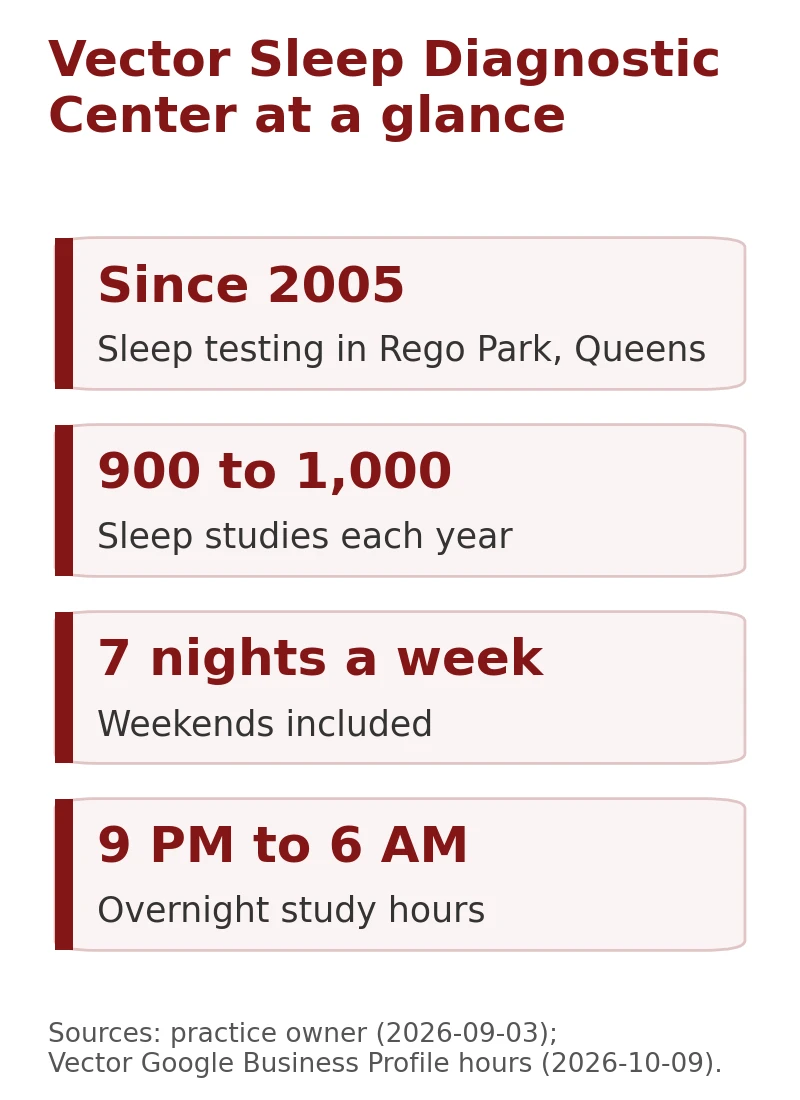
Ask every option two questions: how soon is the first available night, and which nights do they run studies? Some labs test only on certain nights. At Vector, sleep studies run every night, including Saturday and Sunday, from 9 PM to 6 AM, which makes it easier to fit a study around work and family.
How Results Are Reviewed and Explained
A sleep study report is full of unfamiliar terms. Who explains it, and how soon, can matter as much as where you slept. In a hospital system, results may go back to the doctor who referred you, and you hear about them at your next visit there. At an independent center that also sees patients for follow-up, the team that ran your study can usually walk you through the findings directly. Whichever you choose, ask:
- Which physician reads and signs my study, and what are their board certifications?
- Will someone review the results with me, or are they sent only to my referring doctor?
- How long after the study will I hear about results?
At Vector, care is overseen by our medical director, a physician board certified in neurology and sleep medicine. You can read about our medical director before you book.
Continuity of Care After a Diagnosis
What happens after the test matters for conditions like sleep apnea that need ongoing follow-up. The NHLBI notes that untreated sleep disorders can raise your risk of heart failure, high blood pressure, stroke, diabetes, and depression (NHLBI). A setting that keeps testing, results, and follow-up together means fewer handoffs. Ask whether the center you choose offers sleep apnea care after diagnosis or sends you elsewhere for treatment.
Accreditation and Insurance Apply to Both
Hospital labs and independent centers can both be accredited, and the American Academy of Sleep Medicine accredits services separately, so check that the exact test you are booking is covered. Our guide to finding the right sleep disorder center in Rego Park lists what else to check. Coverage is the other practical check: call your plan and the center before the study. Vector accepts all major insurance plans, including Medicare and Medicaid, and our article on whether insurance covers a sleep study in New York covers what to ask.
Making the Choice That Fits You
There is no single right answer. If you already get most of your care in one hospital system, or your doctor wants you monitored in a hospital, a hospital lab may be the simplest path. If you want one team from booking to results, flexible nights, and a setting focused only on sleep, an independent center may suit you better. Comparing several local options? See how to choose between sleep clinics in Queens.
Whichever you pick, the most important step is getting tested when a doctor recommends it. Sleep problems that go undiagnosed rarely resolve on their own.
Sleep Testing at Vector Sleep Diagnostic Center
Vector Sleep Diagnostic Center is at 62-60 99th Street in Rego Park, Queens. In-lab sleep studies are our main service, along with EEG studies, including prolonged EEG of 7 to 14 days. We have run sleep testing since 2005, perform 900 to 1,000 sleep studies a year, and serve patients from across New York City.
Deciding where to have your sleep study? Call Vector Sleep Diagnostic Center and our Rego Park team will answer your questions first.
Ask About a Sleep Study at Vector
Send your details and our Rego Park team will contact you about testing and insurance.
Frequently Asked Questions
Is a sleep study at an independent center as accurate as one in a hospital?
An in-lab sleep study records the same signals in either setting. What usually differs is scheduling, the room, and how results are explained. Ask any center which physician reads your study and whether the service is accredited.
Do I need a referral for a sleep study?
Most sleep studies are ordered by a doctor, and your insurance plan may require a referral. Call Vector at (718) 830-2800 and our team will tell you what your plan needs.
What if I cannot sleep during the study?
According to the American Academy of Sleep Medicine, many patients do not sleep as well as at home, this typically does not affect the results, and in most cases you do not need a full eight hours of sleep for a diagnosis.
When do overnight studies run at Vector?
Vector runs sleep studies every night, including Saturday and Sunday, from 9 PM to 6 AM, at our location in Rego Park, Queens.
Does Vector accept insurance?
Yes. Vector accepts all major insurance plans, including Medicare and Medicaid. Call (718) 830-2800 to confirm coverage for your plan before your study.
Choosing where to have a sleep study is worth a phone call. Call Vector Sleep Diagnostic Center in Rego Park at (718) 830-2800 or request an appointment online.