What to Bring to Your RLS Consultation: Iron Labs, Medication List, Family History
What to bring to your RLS consultation comes down to four records: your iron blood tests, a list of every medicine and supplement you take, your family history, and any past RLS treatment with how it worked. Restless legs syndrome is diagnosed from your history, and the American Academy of Sleep Medicine (AASM) says your doctor will ask about your medical history, your medicines and whether a relative has had a sleep disorder. This guide explains what to gather and why each item matters before your specialized sleep evaluation at Vector Sleep Diagnostic Center in Rego Park, Queens.
Vector has served patients since 2005 and runs 900 to 1000 overnight sleep studies a year. Our medical director, Dr. Dmitriy Kolesnik, is board certified in neurology and sleep medicine.
How Restless Legs Syndrome Is Diagnosed
The 2024 guideline from the German Sleep Society and the German Neurological Society says a diagnosis requires all five essential criteria of the International Restless Legs Syndrome Study Group. They describe an urge to move the legs, often with uncomfortable sensations, that begins or worsens during rest, is relieved at least partly by movement, and is worse or only present in the evening or at night, with the symptoms not explained by another condition. The AASM adds that the feeling is hard to describe and is often called itchy, crawling, creepy or throbbing, and that it usually gets worse when you lie down.
Because the diagnosis rests on your history, the records you bring shape the visit. The AASM says the doctor may also ask you to keep a sleep diary for two weeks, order blood tests, and recommend a sleep study if another sleep disorder may be disturbing your sleep.
Iron Studies: Ferritin, Transferrin Saturation and Blood Count
Iron status is the first lab topic in an RLS workup. The AASM lists low iron levels as one cause of restless legs syndrome and says your doctor may order blood tests including ferritin and an iron panel. The German guideline goes further: iron metabolism and a blood count should be determined in all patients with RLS, at diagnosis, at the start of therapy and whenever symptoms get worse.
- Serum ferritin: the main iron storage marker. The German guideline gives a ferritin of 75 micrograms per liter or lower as the level at which oral iron is given for mild RLS.
- Transferrin saturation, serum iron and iron binding capacity: the other three parts of the iron panel the German guideline names.
- Complete blood count (CBC): listed in the same guideline recommendation, and useful context for the iron results.
Bring the actual numbers and the date each test was drawn, not a summary such as ‘my iron was low.’ Do not start iron on your own. The AASM says to talk with your doctor and not to attempt supplements by yourself. A 2014 review of RLS adds that peripheral blood iron and ferritin values are not always good predictors of iron levels inside cells, which is one reason your doctor reads the results together with your symptoms.
Your Current Medication and Supplement List
Some medicines can cause restless legs symptoms or make them worse, and your doctor needs to find them before choosing any treatment. The AASM lists these groups:
- Allergy medicines
- Many antidepressants
- Antihistamines and over the counter sleep aids
- Nearly all centrally active dopamine receptor antagonists, including anti nausea medicines
The German guideline gives specific examples: selective serotonin reuptake inhibitors, tricyclic antidepressants, metoclopramide and diphenhydramine can exacerbate RLS symptoms. For each product, write the name, dose, how often you take it and when you started. Include over the counter products, supplements, and seasonal cold or allergy medicine. If you want background on how medicines affect sleep in general, see our post on whether certain medications worsen sleep disorders. Never stop a prescription because of a list like this one. Your doctor decides what to change.
Family History
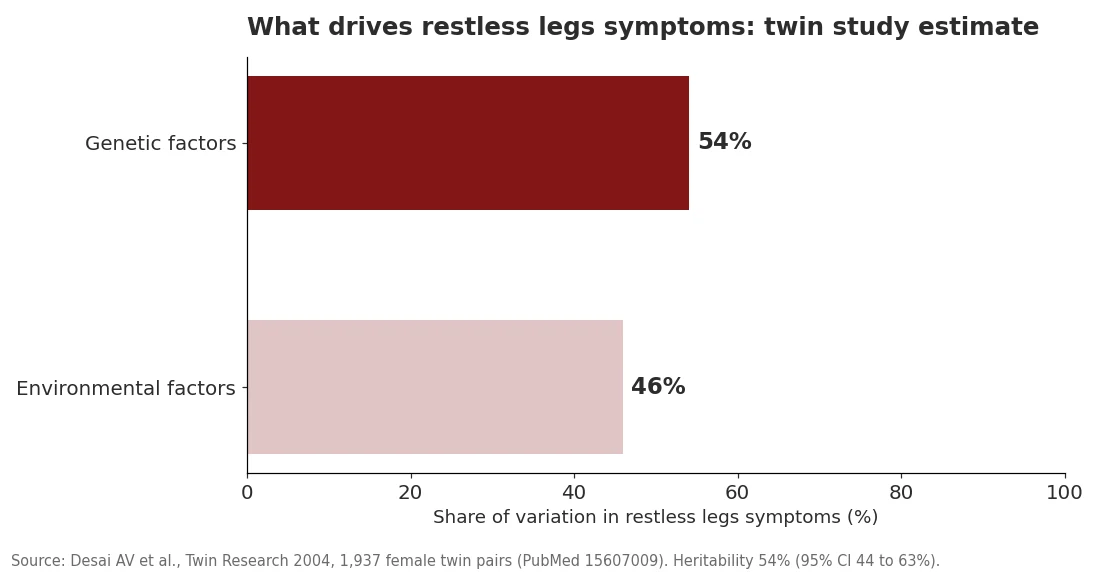
The AASM says more than half of people with restless legs syndrome have a pattern of it in their family, with a risk about three to six times greater, and that having a relative with RLS makes symptoms more likely to start before age 45. The German guideline reports a positive family history in 40 percent to 92 percent of people with early onset RLS, which it defines as onset before age 45. A twin study of 1,937 female twin pairs estimated that genetic factors account for 54 percent of the variation in self-reported RLS symptoms (95 percent confidence interval 44 to 63 percent).
Write down which relatives had restless legs or a similar sleep complaint, the relationship (parent, sibling or child), the age symptoms began, and what helped them. A short note is enough. For more on the inherited side, read our guide to restless leg syndrome genetics.
Treatment History and Augmentation
If you have been treated for RLS before, bring a timeline. The German guideline calls augmentation the most frequent and clinically relevant side effect of dopaminergic therapy and says patients on these medicines should be monitored for it routinely. It is diagnosed from the history, so your own account matters. The criteria it lists are:
- Symptoms start about 2 hours earlier than before
- Symptoms spread to other parts of the body
- Symptoms are more intense than when therapy started
- The dopaminergic medicine has a weaker effect
For each past treatment, note the drug name and dose at the start, how and when the dose changed, whether symptoms moved earlier in the day or spread, and why it was stopped. The guideline says the dose of a dopamine agonist should be kept as low as possible to prevent augmentation, and that only one dopaminergic substance should be used. It describes dopamine agonists and gabapentinoids (gabapentin or pregabalin) as the initial drug options in Germany, Austria and Switzerland, with opioids as second line medicines after augmentation or treatment failure. Treatment in the United States is your doctor’s call. Our overview of treatment options for restless leg syndrome in adults covers the choices.
A Two Week Symptom Diary
The AASM says your sleep doctor may ask you to keep a sleep diary for two weeks. Start before the visit. For each day, note when symptoms start, which body parts are involved, how strong they are, what brings relief, and how they affected your sleep. Our sleep diary template gives you a layout to copy. The German guideline names three validated scales for rating RLS severity and course once the diagnosis is established, the IRLS severity scale, the RLS-6 scale and the Augmentation Severity Rating Scale, so a written diary gives your doctor a starting point to compare against those scales.
Pre-Visit Quick Reference
| Bring | Why it matters |
|---|---|
| Serum ferritin, transferrin saturation, iron and iron binding capacity | The German guideline says to determine iron metabolism in all patients with RLS. |
| Recent complete blood count | Named in the same guideline recommendation as the iron studies. |
| Every medicine and supplement, with doses and start dates | The AASM and the German guideline list medicines that can worsen RLS. |
| Relatives with RLS or a similar complaint | The AASM says a family pattern is common and raises risk three to six times. |
| Past RLS treatments, doses, and what changed | Needed to check for augmentation after dopaminergic therapy. |
| Two week symptom diary | The AASM says your sleep doctor may ask for a two week sleep diary. |
Sleep Apnea, Sleep Studies and Your Bed Partner
The AASM says a sleep study is not required to diagnose restless legs syndrome, but your doctor may recommend one to detect sleep apnea or other sleep disorders that are disrupting your sleep, and that managing conditions such as obstructive sleep apnea can sometimes help control RLS symptoms. The German guideline says polysomnography can rule out sleep related breathing disorders. If you snore loudly or wake gasping, read about sleep apnea care and how a sleep study works, and see our night before sleep study checklist.
If you share a bed, ask your partner to write a few lines about what they have seen, such as leg movements or how often you get up at night. That note is a practical addition to your own history, not a replacement for it. Periodic limb movements can also happen during sleep without you feeling them, and the AASM describes them as a related problem to RLS.
Get in Touch With Our Team
Bring these records to a team that sees sleep disorders every day. Vector Sleep Diagnostic Center in Rego Park, Queens, can review your history and explain your options. Email vectorsleep@gmail.com or call (718) 830-2800.
Frequently Asked Questions About Your RLS Consultation
Do I need a sleep study to be diagnosed with restless legs syndrome?
No. The American Academy of Sleep Medicine says a sleep study is not required to make the diagnosis, although your doctor may recommend one to detect sleep apnea or other sleep disorders that disrupt your sleep. A 2024 guideline from the German sleep and neurological societies says polysomnography is not mandatory for RLS but can rule out sleep related breathing disorders.
Which blood tests should I bring to an RLS visit?
The German guideline says iron metabolism, meaning serum ferritin, transferrin saturation, iron and iron binding capacity, plus a blood count, should be determined in all patients with RLS at diagnosis, at the start of therapy and whenever symptoms get worse. The American Academy of Sleep Medicine says your doctor may order blood tests that include ferritin and an iron panel. Bring any recent results you already have.
Should I start taking iron on my own before the visit?
No. The American Academy of Sleep Medicine advises against taking iron supplements on your own if you think low iron is behind your symptoms, and says to talk with your doctor first. Iron treatment is decided from your lab values, and the German guideline describes oral iron for mild RLS with a ferritin of 75 micrograms per liter or lower, and intravenous iron for moderate to severe RLS or when oral iron is not tolerated.
Can my current medicines make restless legs worse?
They can. The American Academy of Sleep Medicine lists allergy medicines, many antidepressants, antihistamines and over the counter sleep aids, and nearly all centrally active dopamine receptor antagonists, including anti nausea medicines. The German guideline names SSRIs, tricyclic antidepressants, metoclopramide and diphenhydramine. Do not stop a prescription on your own. Bring the full list so your doctor can review it.
What is augmentation, and why does my history of treatment matter?
The German guideline calls augmentation the most frequent and clinically relevant side effect of dopaminergic therapy for RLS. It is diagnosed from your history: symptoms start about 2 hours earlier, spread to other parts of the body, grow more intense than when therapy started, and the medicine works less well. Bring your treatment timeline so your doctor can check for it.
Does RLS run in families?
Often. The American Academy of Sleep Medicine says more than half of people with RLS have a family pattern, with a risk about three to six times greater, and that people with a relative with RLS are more likely to develop symptoms before age 45. A twin study of 1,937 female twin pairs estimated that genetic factors explain 54 percent of the variation in self-reported RLS symptoms.
Sources
- American Academy of Sleep Medicine, Sleep Education: Restless Legs Syndrome (October 2024), symptoms, causes, medicines, family pattern, diagnosis and treatment
- Restless legs syndrome: abbreviated guidelines by the German sleep society and the German neurological society (Neurological Research and Practice, 2024), diagnostic criteria, iron studies, medicines that worsen RLS, augmentation
- Restless leg syndrome: a neglected diagnosis (review, 2014), iron and ferritin background
- Genetic influences in self-reported symptoms of obstructive sleep apnoea and restless legs: a twin study (Twin Research, 2004), heritability estimate