Sleep Study New York: What to Expect and How Vector Sleep Clinic Can Help
Sleep Study New York: What to Expect and How Vector Sleep Clinic Can Help
Getting a good night’s sleep sounds simple, but for millions of people across New York City, it is anything but. You lie down, close your eyes, and hours later you wake up exhausted, or your partner tells you that you stopped breathing in the night, or you drift through the day in a fog that coffee cannot fix. If any of that sounds familiar, a sleep study may be exactly what you need. At Vector Sleep Diagnostic Center in Rego Park, Queens, we help patients across New York City find real answers, not guesses, about what is happening while they sleep.
This guide walks you through everything you should know about sleep studies in New York: what they involve, who needs one, how the process works at our clinic, and what comes after your results.
Why So Many New Yorkers Struggle with Sleep
New York City is loud, fast, and never fully dark. That combination creates a challenging environment for sleep. Shift work, long commutes, artificial light late into the night, and chronic stress all put pressure on the body’s natural sleep cycle. It is no surprise that sleep disorders are common here.
But the environment is only part of the story. Sleep disorders like obstructive sleep apnea, insomnia, restless leg syndrome, and periodic limb movement disorder are medical conditions with physiological causes. They do not go away by simply going to bed earlier or cutting back on caffeine. They require proper diagnosis, and that means a sleep study.
Research consistently shows that untreated sleep disorders raise the risk of high blood pressure, heart disease, type 2 diabetes, and mood disorders. If you are not sleeping well night after night, the effects accumulate. The sooner you get answers, the sooner you can start feeling better. You can also read more about how common sleep disorders are in children of New York City residents, because this is not only an adult problem.
Certain factors also increase a person’s likelihood of developing a sleep disorder over time. Aging is one of them, and you can learn more about how aging affects the prevalence of sleep disorders in New York City on our site.
What Is a Sleep Study and Who Needs One
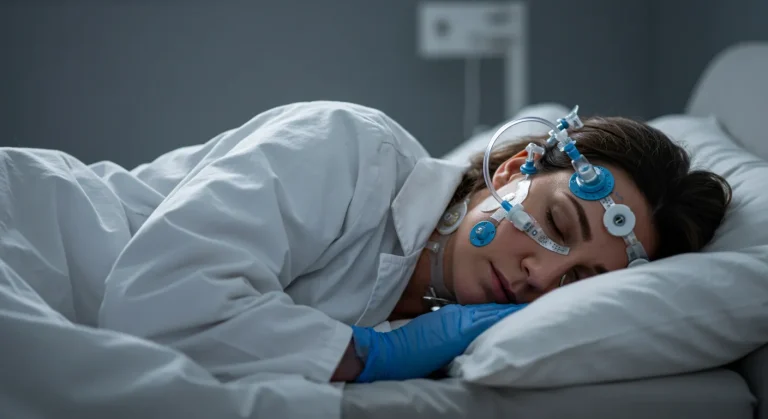
A sleep study, also called a polysomnogram, is a test that records what your body does while you sleep. Sensors placed on your body track brain activity, eye movement, muscle activity, heart rate, breathing patterns, blood oxygen levels, and body position. None of this is painful. You are simply monitored through the night so clinicians can see exactly what is and is not working.
You may be a good candidate for a sleep study if you experience any of the following:
- Loud, frequent snoring
- Gasping, choking, or pauses in breathing during sleep (often noticed by a partner)
- Waking up repeatedly through the night without a clear reason
- Excessive daytime sleepiness despite getting enough hours in bed
- Morning headaches or a dry, sore throat when you wake up
- Difficulty concentrating or memory problems during the day
- Restless or uncomfortable feelings in your legs at night
- Sleepwalking or other unusual behaviors during sleep
If you have been struggling to stay asleep, a sleep study can identify the cause in a way that guesswork simply cannot. Many people live with these symptoms for years before they realize a diagnosis is available.
In-Lab Sleep Testing at Vector Sleep Diagnostic Center
Vector Sleep Diagnostic Center provides in-person, in-lab sleep testing. Our facility is located in Rego Park, Queens, making it convenient for patients throughout the five boroughs and surrounding areas.
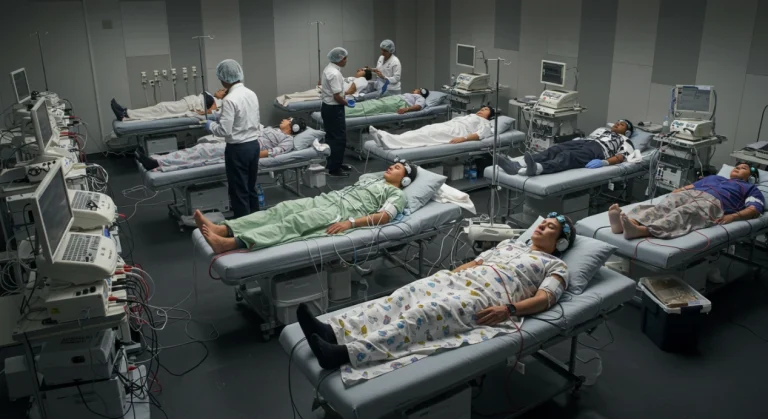
In-lab testing means you spend the night at the clinic. You arrive in the evening, get settled into a private room, and our technicians apply the sensors and electrodes that will record your sleep data. The setup process takes about an hour and involves no discomfort. Once the sensors are in place, you simply go to sleep. The room is designed to be as comfortable and quiet as possible, and the monitoring equipment runs quietly in the background.
Our technicians are present throughout the night to make sure everything is recording correctly and to assist if you need anything. In the morning, you disconnect the sensors, get ready, and head home or to work. The data collected overnight is then reviewed by our clinical team.
In-lab testing captures the most complete picture of your sleep. It records a full range of physiological signals that home devices cannot match. If your doctor suspects a complex or less common sleep disorder, in-lab testing is generally the recommended approach. To understand how in-lab testing compares to at-home options, you can read our detailed breakdown of at-home versus in-lab sleep studies.
From Your First Appointment to Your Diagnosis
At Vector Sleep Clinic, we handle everything locally. You are not routed through a call center in another state or handed off to a different facility for follow-up. Our own team manages your appointment from start to finish.
Your care is overseen by Dr. Dmitriy Kolesnik, our board-certified sleep medicine specialist, from the first consultation through your results review. Here is how the process typically works:
- Initial consultation: You speak with our clinical team about your symptoms and medical history. This helps us determine which type of sleep study is right for you.
- Scheduling: We set up your overnight study at a time that works for your schedule. Our team handles all the coordination directly.
- The study night: You come to our Rego Park clinic, get set up, and sleep while our equipment records your data.
- Results review: After the study, our team reviews your results with you. We explain what the data shows in plain language so you understand your diagnosis and what it means for your health.
- Next steps: Depending on what we find, we discuss treatment options and coordinate your care going forward. Sleep apnea, for example, has effective treatments that can produce a dramatic improvement in how you feel.
The goal is that you leave with a real answer, not a pile of paperwork you have to figure out on your own. We take you from the point of not knowing what is wrong to understanding your diagnosis and having a clear plan.
Sleep Apnea: The Most Common Diagnosis and What Happens After
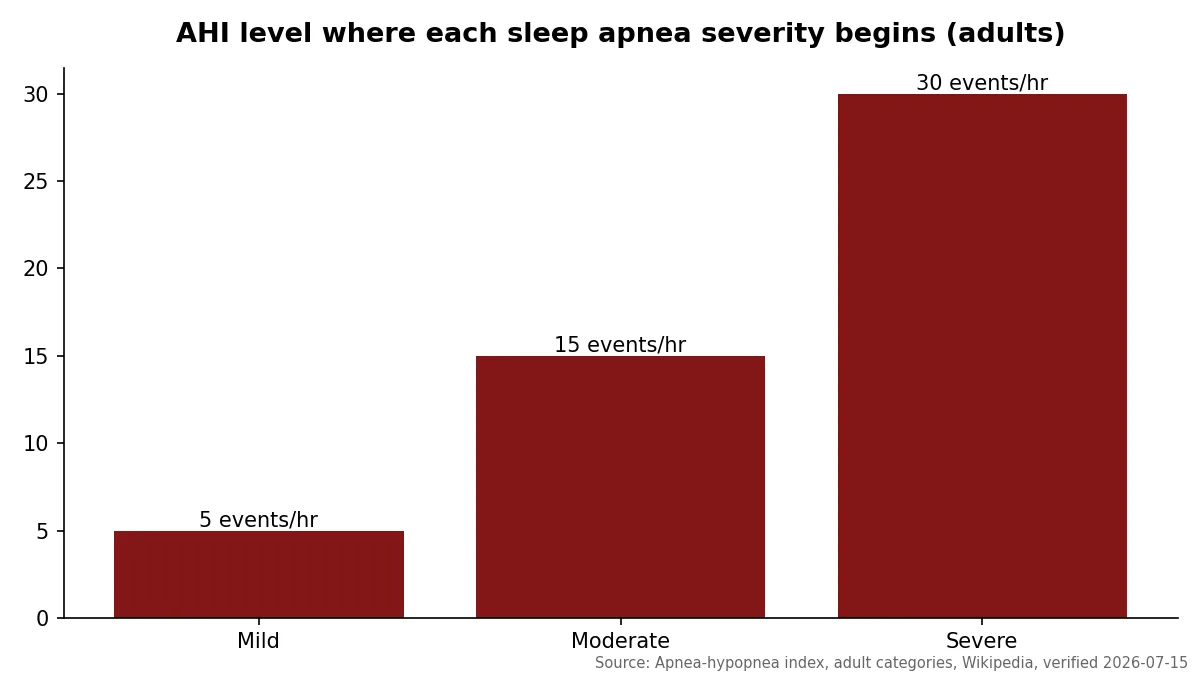
Obstructive sleep apnea is the most frequently diagnosed sleep disorder in adults. It happens when the muscles in the throat relax during sleep and block the airway, causing breathing to pause repeatedly through the night. In severe cases, these pauses can happen 30 or more times per hour. Each one jolts the brain just enough to restore breathing, but not enough to fully wake you. The result is fragmented sleep and chronic oxygen deprivation, even if you have no memory of waking up.
According to the National Heart, Lung, and Blood Institute, sleep apnea is linked to serious cardiovascular risks when left untreated. Catching it early and treating it effectively matters.
The most common treatment for obstructive sleep apnea is continuous positive airway pressure therapy, known as CPAP. A CPAP machine delivers a steady stream of air through a mask worn during sleep, keeping the airway open. Many people find that their energy, mood, and concentration improve within the first few weeks of treatment.
If you are searching for a sleep apnea doctor serving Manhattan, our Rego Park clinic is a short trip on the R or M train. At Vector Sleep Clinic, we do not just diagnose and disappear. We review your results, explain the diagnosis, and discuss treatment so that you know what your options are and how to move forward.
Other Sleep Disorders We Diagnose
Sleep apnea gets a lot of attention, and rightly so, but it is not the only condition a sleep study can identify. In-lab polysomnography can detect a range of sleep disorders, including:
- Periodic limb movement disorder (PLMD): Involuntary leg or arm movements that occur during sleep and disrupt rest without the person always realizing it.
- Restless leg syndrome (RLS): An uncomfortable urge to move the legs, especially in the evening and at night, that interferes with falling asleep.
- REM sleep behavior disorder: A condition in which the normal muscle paralysis that occurs during REM sleep is absent, causing people to physically act out their dreams.
- Narcolepsy: A neurological disorder that causes overwhelming daytime sleepiness and sudden sleep attacks.
- Upper airway resistance syndrome: A less severe form of sleep-disordered breathing that still disrupts sleep quality night after night.
Some sleep disorders also run in families. If you are wondering whether your own sleep problems might be connected to your family history, you can read about whether sleep disorders can be hereditary in New York City families.
Lifestyle Factors That Can Make Sleep Worse
While a sleep study addresses medical diagnoses, it is also worth understanding the everyday habits that affect sleep quality. Screen time is a major one. The blue light emitted by phones, tablets, and computers suppresses melatonin production and signals to the brain that it is still daytime. You can read more about whether technology usage before bedtime worsens sleep patterns in New York City residents.
Anxiety is another major disruptor. Many people lie awake with racing thoughts, and the cycle of poor sleep feeding more anxiety, and more anxiety feeding poor sleep, can feel impossible to break. Our site has information on effective strategies for managing anxiety-induced sleep disorders in New York City residents that may be a useful starting point.
Addressing lifestyle factors alongside a medical diagnosis gives you the best chance of meaningful, lasting improvement. The Centers for Disease Control and Prevention offers clear public guidance on sleep health habits that support better rest.
Why Vector Sleep Diagnostic Center
Vector Sleep Diagnostic Center has been serving patients in Queens and across New York City with focused, specialized sleep medicine care. Our clinic exists for one purpose: diagnosing and treating sleep disorders. We are not a general practice that happens to offer sleep testing on the side. Sleep is all we do, and that concentration of focus means that our team has built meaningful experience in recognizing the full range of sleep disorders, interpreting polysomnography data accurately, and explaining results in a way that makes sense to patients.
We are based in Rego Park, which puts us in a genuinely central location for patients coming from across Queens, Brooklyn, Manhattan, the Bronx, and Staten Island. Every appointment is handled by our own team. There is no outsourcing of scheduling, no remote reading of your results by someone who has never spoken to you. When you come to Vector Sleep Clinic, you work directly with the people who provide your care.
We also believe that a diagnosis is only useful if you understand it. After your sleep study, we sit down with you, review the results, and make sure you leave knowing what was found, what it means, and what the recommended next steps are. That is the complete path we offer, from your first night of poor sleep to a clear diagnosis and a treatment plan.
If you are looking for community support beyond clinical care, there are also support groups for people with sleep disorders in New York City that some of our patients have found helpful alongside their treatment.
Frequently Asked Questions
How do I know if I need a sleep study?
If you snore loudly, wake up repeatedly during the night, feel exhausted during the day despite sleeping for a full night, or have been told you stop breathing while you sleep, those are strong reasons to speak with a sleep specialist. A sleep study is the only reliable way to confirm or rule out conditions like sleep apnea. Our team can discuss your symptoms with you and help you decide whether a study is the right next step.
Is an in-lab sleep study uncomfortable?
Most patients find the experience more manageable than they expected. The sensors and electrodes are applied to the surface of your skin and scalp with mild paste or adhesive tape. Nothing is inserted into the body, and nothing is painful. The room is private and set up to be as comfortable as possible. Many patients sleep well enough during the study for the results to be fully useful, even if they do not sleep quite as well as they would at home.
How long does it take to get results?
After your overnight study, our clinical team reviews the data collected. We then schedule a follow-up to go over the results with you directly. We aim to make this process as timely as possible so that you are not left waiting and wondering. Our team will give you a realistic timeline when you complete your study.
Does insurance cover a sleep study?
Many insurance plans do cover sleep studies when they are medically indicated, meaning your doctor or sleep specialist has documented symptoms that support the need for testing. Coverage details vary by plan, so we recommend contacting your insurance provider before your appointment to understand your benefits and any potential out-of-pocket costs. Our team can help you with any documentation needed for prior authorization.
What happens if I am diagnosed with sleep apnea?
A diagnosis of sleep apnea is the beginning, not the end. Once we know what is happening during your sleep, we can talk through your treatment options. The most common and well-studied treatment for obstructive sleep apnea is CPAP therapy, which has helped a large number of people reduce symptoms and feel considerably better. We review the diagnosis with you in full so that you understand what is going on and feel prepared to take the next step.
If you have been putting off looking into your sleep problems, now is a good time to act. Vector Sleep Diagnostic Center is here to help you find out what is actually going on, explain it clearly, and point you in the right direction. Call us at (718) 830-2800 or schedule your consultation online. We serve patients throughout New York City from our clinic in Rego Park, Queens, and we handle everything in house, from your first appointment to your follow-up care.